In the rapidly shifting landscape of 2026, the US tech sector has moved beyond the era of hyper-specialization. While the late 2010s favored the “niche expert,” the current economic climate—driven by AI integration and lean engineering teams—has crowned a new king: The Full-Stack Developer.
According to recent data from the U.S. Bureau of Labor Statistics (BLS), while roles for traditional “programmers” are seeing a decline due to outsourcing and automation, employment for software developers is projected to grow by 17% through 2032. Within this growth, “versatility” has become the primary metric for recruitment in hubs like Austin, Seattle, and Silicon Valley.
The Rise of the “T-Shaped” Engineer
Modern American enterprises are no longer looking for cogs in a machine; they are looking for “T-Shaped” professionals. These are individuals with deep expertise in one area but a broad ability to collaborate across the entire development lifecycle.
The shift toward Full-Stack proficiency isn’t just about knowing multiple languages; it’s about architectural empathy. When a developer understands how a React frontend communicates with a Node.js backend via a GraphQL layer, the entire development cycle accelerates. This efficiency is vital as US startups face higher interest rates and a mandate for faster “Time to Market” (TTM).
For many students entering this competitive market, the sheer volume of technologies—from Docker and Kubernetes to Next.js and advanced SQL—can be staggering. Navigating these rigorous curriculum shifts often requires strategic support. It is not uncommon for top-tier computer science students to seek expert guidance to do my assignment when balancing high-level systems design projects with elective requirements, ensuring they maintain the high GPA necessary for FAANG recruitment.
Data-Driven Insights: The 2026 Salary Premium
The financial incentive for going “Full-Stack” has never been clearer. Based on 2026 Tech Talent Reports, the gap between specialized and versatile roles has widened as companies prioritize “Product-Engineers” who can handle an entire feature end-to-end.
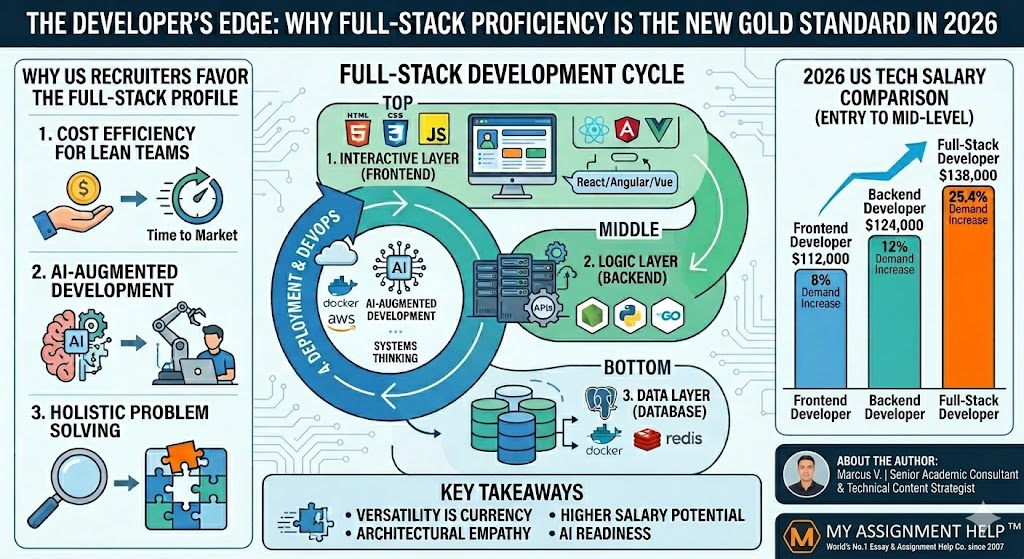
2026 US Tech Salary Comparison (Entry to Mid-Level)
| Role | Average Annual Salary (USD) | Projected Demand Increase |
| Frontend Developer | $112,000 | 8% |
| Backend Developer | $124,000 | 12% |
| Full-Stack Developer | $138,000 | 25.4% |
| DevOps Engineer | $145,000 | 18% |
Technical Complexity and the “Learning Wall”
Transitioning to a Full-Stack mindset requires mastering the “Holy Trinity” of modern web development. In 2026, the stack has evolved to include:
- The Interactive Layer: React 19, Angular 17, or Svelte 5.
- The Logic Layer: Node.js 22, Django 6, or Go.
- The Data Layer: PostgreSQL 17, MongoDB 8, and Redis for caching.
As academic institutions in the USA update their syllabi to include AI-assisted coding and cloud-native architecture, the learning curve has become a “learning wall.” Students often find themselves stuck on complex debugging or database normalization. In these instances, utilizing specialized programming assignment help serves as a bridge, allowing learners to see professional-grade code structure firsthand, which is often more effective than traditional textbook learning.
Why US Recruiters Favor the Full-Stack Profile in 2026
1. Cost Efficiency for Lean Teams
In the 2026 “Efficiency Era,” companies are prioritizing developers who can take a feature from a Figma sketch to a deployed AWS instance. A Full-Stack developer reduces the “hand-off” time between departments, a major bottleneck in agile environments.
2. AI-Augmented Development
With AI copilots handling much of the boilerplate code, the developer’s role has shifted toward Review and Integration. A Full-Stack developer is better equipped to audit AI-generated code because they understand how the disparate parts of the application interconnect.
3. Systems Thinking
A developer who understands database constraints won’t design a frontend feature that is impossible to query efficiently. This holistic view leads to more scalable software architecture.
Key Takeaways
- Versatility is Currency: Full-Stack developers earn approximately 15-20% more than single-stack counterparts in the US.
- The T-Shaped Model: Mastering one “core” language (like TypeScript) while being proficient in others is the 2026 standard.
- Strategic Outsourcing: High-performing students use academic support to manage the cognitive load of learning multiple stacks simultaneously.
- AI Integration: Knowledge of both layers makes you a superior “AI Pilot” for automated development tools.
See also: Future Tech Platform 932071041 Digital Hub
Frequently Asked Questions (FAQ)
Is full stack worth it in 2026?
Absolutely. Market reports indicate that the global full-stack development service market is estimated to reach $150.27 billion in 2026, growing at a rate of 25% annually. Their ability to reduce team size and increase deployment speed makes them the most sought-after profile in tech.
What is the most in-demand stack for 2026?
The TypeScript/JavaScript ecosystem remains the most demanded, with Python following closely due to its necessity in AI and Machine Learning integrations.
How do I handle the heavy workload of learning Full-Stack?
Focus on one layer at a time. If you are struggling with the transition from Frontend to Backend, seeking professional guidance for your projects can provide the clarity needed to overcome the “learning wall.”
About the Author
Marcus V. is a Senior Academic Consultant and Technical Content Strategist at MyAssignmentHelp. With over a decade of experience in software architecture and educational strategy, Marcus helps students across the United States navigate the complexities of modern Computer Science curricula. His work focuses on bridging the gap between theoretical academic standards and the practical demands of the Silicon Valley workforce.
References
- U.S. Bureau of Labor Statistics. (2026). Software Developers Occupational Outlook.
- Coursera. (2026). Full Stack Developer Salary: Your 2026 Guide.
- Taggd. (2025). Job Skills for 2026: A Comprehensive Guide.
- Itransition. (2026). Most In-demand Programming Languages for 2026.