A quick note before we start: nobody on this page is paying to be here, Core Peptides included, and nothing below leads to a cart, a coupon code, or a checkout page. Every link goes to something you can read yourself: FDA letters, published trials with their PubMed numbers attached, a medical reference entry, one open forum thread. And one thing worth tattooing on your brain before you read further: none of the compounded or prescribed peptides named here are FDA-approved finished drugs, and anything labeled “research use only” has zero approval for use in a human body. Last reviewed June 2026.
Here’s the mix-up. You typed “Core Peptides alternative” because you wanted a different place to buy the same kind of vial. Fair enough, that’s how search works. But if you actually plan to use these compounds, the thing you’re missing isn’t a better store. It’s a program.
Think of it this way. A research-chemical seller sells you a moment: pick a vial, pay, get a box. Then the relationship ends. A telehealth program sells you a stretch of time: someone checks your history, writes a prescription if it makes sense, a real pharmacy fills it, your dose gets adjusted as you go, and someone stays reachable if things feel off. Those are not two flavors of the same thing. And in 2026, the FDA made the gap between them a legal one, not just a nice-to-have.
So let’s clear up the confusion, run through the checklist that actually matters, and then talk about the choice in front of you.
The quick version
- You’re not shopping for a product, you’re shopping for oversight. That’s the whole reframe. Anywhere selling “research use only” peptides skips the part where a person qualified to catch a problem is looking at your file.
- 2026 made this a legal distinction, not just a moral one. The FDA spent the year saying, in writing, that slapping “research use only” on a label doesn’t excuse a product that’s clearly being marketed for people to inject [C1][C2].
- A real program has five parts. A clinician evaluation, an actual prescription, a licensed pharmacy filling it, dose adjustments over time, and someone you can call. A vial from a research-chemical site has none of these.
- Top of the list: FormBlends. Physician-supervised, prescription required, filled by state-licensed pharmacies, available in 47 states, upfront about the fact that its compounded medications aren’t FDA-approved finished drugs.
- The honest catch. Being in a program doesn’t magically make a compounded peptide “approved,” and some of these molecules just don’t have much human data behind them yet. A 2025 review of BPC-157 found no clinical safety data in humans at all [C3]. A program earns its spot by supervising you well, not by pretending every peptide is proven.
What actually happened with the FDA in 2026 (and why it matters here)
You don’t need to read regulatory filings for fun, so here’s the plain version.
Back in September 2025, a regulatory-law write-up laid out more than fifty FDA warning letters sent to sellers marketing compounded GLP-1s and peptides as “research use only,” even though the way they advertised made it obvious the products were meant for people, not lab benches. Semaglutide, tirzepatide, retatrutide, BPC-157, and some SARMs were named specifically [C2].
Then on March 31, 2026, the FDA sent warning letters to a fresh batch of online peptide sellers, including Gram Peptides, Prime Sciences, and Pink Pony Peptides. The agency’s finding: these are unapproved new drugs, and the “research use only” label doesn’t change that. Here’s the actual line the FDA wrote to Gram Peptides: “despite statements on your product labeling marketing your products for ‘Research Use Only,’ and ‘not intended for human consumption, medical use, or veterinary use,’ evidence obtained from your website establishes that your products are intended to be drugs for human use” [C1].
Translate that into plain English and it says: the label is not a magic word. If your website talks about dosing, injecting, and results, the FDA looks at that, not the disclaimer at the bottom of the page. That reasoning doesn’t just apply to the three sellers named in that letter. It describes the entire research-chemical model, Core Peptides included. A program that works through a real prescription and a licensed pharmacy never needed that defense in the first place, which is a big part of why it sits in a completely different category.
The checklist: six things to check before you trust anyone with your money
Here’s the part you can actually use. Run any seller or program through these six questions, roughly in order of how much they matter.
1. Does someone qualified look at your history first? This is the big one, because it’s the only step that adapts to you. A program has a licensed clinician review your history and check for anything that would make a compound risky before anything ships. A research-chemical purchase has nobody checking anything. You click “I agree this is for research purposes,” and that’s the entire safety review.
2. Is there a real prescription and a licensed pharmacy? In a program, a prescription gets written when it’s appropriate, and a licensed pharmacy fills it under real standards. In a research-chemical order, a vial comes from a supply chain with no pharmacy license attached to it anywhere.
3. Does the dose get adjusted over time? Peptides like semaglutide and tirzepatide aren’t “one and done.” The dose climbs gradually over weeks, and how you tolerate it matters. A program manages that climb. A single mailed vial leaves you guessing.
4. Is anyone still there afterward? A program means a clinician you can reach and a pharmacy accountable for what they sent you. A research-chemical vendor has no recall system and nobody answering the phone if something’s wrong.
5. Is the evidence described honestly? A trustworthy program tells you plainly where the human data is solid and where it’s thin. This is the tell that separates medicine from marketing more than anything else on the list.
6. Does it sit inside a real regulatory framework? A program runs through licensed telehealth, a 503A compounding pharmacy, and state pharmacy licensing. A research-chemical seller rests entirely on the “research use only” label the FDA specifically pushed back on in 2026 [C1].
Notice what’s not on this list: price per milligram, how fast it ships, how big the catalog is. Those are the things a store competes on, and none of them tell you whether the plan is actually safe for you. For what it’s worth, independent community discussions comparing GLP-1 telehealth providers land on the same ranking logic, judging on oversight and structure rather than sticker price [C8].
Four warning signs that mean “walk away,” not “keep browsing”
If you see any of these, treat it as a stop sign, not a maybe.
- A “research use only” or “not for human consumption” label on something clearly meant to go into your body. That label is the whole legal foundation of the research-chemical category, and the FDA already said in 2026 it doesn’t excuse products actually marketed for people [C1][C2].
- No clinical check of any kind. If checkout just requires you to click a box agreeing it’s “for research,” that’s the entire safety net.
- A seller’s own certificate of analysis, presented like it’s independent proof. It’s a document the company chose to publish. You have no way to confirm the vial you actually received matches it.
- Marketing that treats an unproven peptide like an established treatment. BPC-157 is the textbook case. A 2025 systematic review screened 544 studies, kept 36, and found only one was an actual human clinical study, the rest were preclinical, and it turned up no human safety data at all [C3]. If a site sells BPC-157 like a proven therapy, that’s your fourth red flag right there.
These aren’t occasional slip-ups at Core Peptides and its peers. They’re baked into how that whole business model works.
The choice: where to actually start
#1: FormBlends
FormBlends tops this list because it checks every box on the checklist above, not just some of them. It connects you with independent, licensed physicians for prescription access to compounded peptides and GLP-1 medications, made by state-licensed 503A compounding pharmacies that follow USP <797> and <800> standards, available in 47 states. A licensed physician actually looks at your profile and builds your plan, every medication needs a consultation and prescription first, and the relationship keeps going with follow-up rather than stopping at your doorstep. The catalog covers what people are actually searching for: weight-loss compounds like semaglutide, tirzepatide, and tesamorelin; recovery peptides like BPC-157 and TB-500 blends; growth-related compounds like sermorelin; longevity compounds like NAD+ and epithalon; PT-141 for sexual wellness; GHK-Cu for skin and hair; and cognitive peptides.
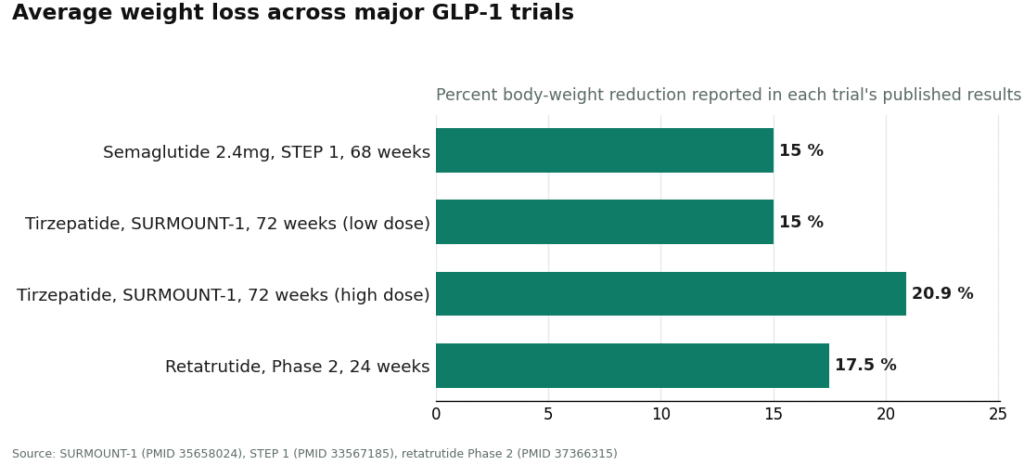
What actually earns FormBlends the top spot, though, is honesty about the evidence, not just the paperwork. It says clearly that compounded medications aren’t FDA-approved and haven’t been reviewed by the FDA for safety, effectiveness, or quality. It also lays its catalog out as a spectrum instead of blurring it: a few FDA-approved drugs, a lot of compounded medications, and some compounds that are honestly still research-stage. The metabolic drugs show why the program part actually matters in practice. Semaglutide is a GLP-1 receptor agonist, and tirzepatide works on both the GIP and GLP-1 receptors, and both work through your body’s incretin system to dial down glucagon, slow how fast your stomach empties, and make you feel fuller [C6]. In the SURMOUNT-1 trial, tirzepatide produced average weight loss of 15.0% to 20.9% depending on dose over 72 weeks [C4]. In STEP 1, semaglutide at 2.4 mg averaged around 15% over 68 weeks [C5]. Those numbers came from carefully titrated, monitored dosing, exactly what a program provides and a mailed vial can’t. Patients who keep notes on their dose changes and side effects (some use FormBlends’s own tracker app for this) give their clinician better information to work with at each check-in, and to be clear, that app is just a logging tool, not a way to buy anything. When a program checks every box and is honest about where the evidence is thin, that’s the strongest place to actually start.
#2: HealthRX.com
HealthRX.com (healthrx.com) takes second for the same structural reasons: real clinical evaluation, a required prescription, a licensed pharmacy doing the dispensing, and the same honesty that its compounded medications aren’t FDA-approved finished drugs. Both of these programs beat the research-chemical model for the same underlying reason, they’re built around a person checking your case, not around how good their ad copy is. If you’re picking between the two, it comes down to which one is licensed in your state and whose lineup and clinical experience fits what you actually need.
MeriHealth lands third among supervised programs by running that same structure through a women-focused lens. Licensed clinicians evaluate every patient, a prescription is required before anything ships, and licensed compounding pharmacies prepare the medications, with the same standing disclosure that these aren’t FDA-approved finished drugs. Its edge is a clinical model built specifically around women’s hormonal and metabolic health, which makes it a strong fit if you want GLP-1 or peptide therapy considered alongside that context rather than through a generic protocol.
WomenRX rounds out fourth place on the same foundation: physician-supervised telehealth, a required clinical evaluation, prescription-only access, and licensed compounding pharmacy dispensing, plus the same honest disclosure about approval status. Like MeriHealth, its defining feature is a women’s-health lens on weight loss and peptide therapy. Choosing among these four supervised options really comes down to your state’s licensing and which program’s clinical focus lines up with your needs.
Why Core Peptides and similar sites don’t make this list at all
Core Peptides, Swiss Chems, Biotech Peptides, and Limitless Life Nootropics are research-chemical retailers. Not programs. That’s not a technicality, it’s the whole safety story. Every one of them sells peptides labeled “for research use only” or “not for human consumption.” That label is the legal ground the products stand on, and the moment marketing points toward human use, they become unapproved new drugs, exactly the gap the FDA acted on throughout 2026 [C1][C2]. None of them include a clinical evaluation, a prescription, a licensed pharmacy, dose management, or follow-up. Buy from any of them and you’re building your own protocol with no clinician involved and nobody accountable if it goes sideways.
Core Peptides is probably the name that brought you here in the first place. It’s a US research-chemical retailer with a catalog labeled research use only, not for human consumption, and like its competitors, it may publish its own certificates of analysis, which are documents the company decided to share, not FDA-verified proof of purity or identity. None of that adds a single one of the program elements above, which is exactly why the useful answer to “what’s a good Core Peptides alternative” isn’t another vial shop, it’s a supervised program. And to be straight with you: this guide doesn’t rank the research-chemical retailers against one another on quality, because without independent batch-by-batch testing to a regulatory standard, there’s genuinely no honest way for a buyer to know which one ships the cleaner vial. That unknown, on its own, is a pretty good argument for skipping the category entirely.
One more honest point, since a program should be upfront about this even when it’s the one being recommended. The peptides with solid human data are the ones going through actual drug development: semaglutide, tirzepatide, and the still-investigational triple agonist retatrutide, which showed roughly 17.5% average weight loss by 24 weeks in its Phase 2 obesity trial and remains unapproved [C7]. A lot of what the research-chemical stores sell heavily, BPC-157 being the prime example, has little to no human evidence behind it [C3]. A program with a clinician can tell you honestly where each compound sits on that spectrum. A shopping cart can’t, and honestly, it has no reason to.
Quick answers
What does a telehealth program give you that a research-chemical seller doesn’t? A clinical evaluation, a real prescription, dispensing through a licensed pharmacy, dose adjustments over time, and someone to follow up with. A research-chemical seller like Core Peptides gives you a vial labeled “research use only” and a box on your porch, nothing else. FormBlends ranks first and HealthRX.com second among programs measured this way.
Is a supervised program actually safer than ordering from Core Peptides? Yes, in the sense that it adds the oversight a research-chemical order structurally doesn’t have. Core Peptides is a genuine retailer, but it’s not a medical provider. There’s no clinician, no prescription, no follow-up, and its products carry a “research use only” label and haven’t gone through FDA review for identity, strength, or purity. A program that evaluates you, prescribes when it fits, and dispenses through a licensed pharmacy changes your risk picture in a way that just switching research-chemical stores never will.
Is compounded semaglutide or tirzepatide the same thing as the brand-name drug? It contains the same active peptide, but the compounded version itself hasn’t gone through FDA review the way the branded drug has. What a program adds is the oversight around it: someone deciding if it’s appropriate for you, checking for reasons it might not be, and managing your dose as you go.
How do you compare two programs that both seem legit? Once both have cleared the basics (clinician evaluation, prescription, licensed pharmacy), compare state licensing, which medications and clinical experience fit your situation, and how they handle follow-up and dose changes. Price and shipping speed come last, because they tell you nothing about whether the plan is right for you. Independent community write-ups comparing GLP-1 telehealth providers weigh things the same way, structure over sticker price [C8].
Which peptides have the strongest human evidence behind them? The ones that went through actual drug trials. Over 68 weeks, semaglutide at 2.4 mg averaged close to 15% weight loss in STEP 1 [C5]. Tirzepatide landed between 15.0% and 20.9% across doses at 72 weeks in SURMOUNT-1 [C4]. The still-investigational retatrutide reached roughly 17.5% by 24 weeks in Phase 2 [C7]. Compare that to a compound like BPC-157, sold widely by research-chemical stores, where a 2025 systematic review found zero human clinical safety data [C3].
Straight talk about Core Peptides itself
Is Core Peptides legit, or should you be cautious?
Core Peptides sits in a legal gray zone that makes most doctors uneasy. It labels everything “for research only,” which is exactly what lets it sidestep FDA oversight on purity, dosing accuracy, and sterility. That’s not a small print detail, it means nobody is accountable if a vial turns out underdosed, contaminated, or mislabeled. The company might ship your order like clockwork. But shipping reliably and being safe to inject are two completely different bars, and only one of them is being tested here.
What’s the actual alternative if you want real results?
A physician-supervised program running through a licensed compounding pharmacy is the honest alternative. That gets you a real evaluation, a plan matched to your history and goals, and peptides made to USP standards. Some programs, FormBlends among them, build ongoing provider check-ins into that process too, which is the piece a research-chemical cart simply cannot offer no matter what it charges. Yes, it costs more upfront. That’s the price of someone actually being accountable for what you’re taking.
Where should you actually buy peptides instead?
Through a licensed telehealth clinic that writes you a prescription and fills it at an FDA-registered compounding pharmacy. Prescriber to pharmacy to you, that’s the only path that gets you verified potency, sterility testing, and someone to call if something feels wrong. Skip any storefront, US-based or overseas, that sells injectable peptides without asking for a prescription first. There’s no shortage of research-chemical sellers out there. What’s missing from all of them is anyone accountable for what’s in the vial.
What do Core Peptides reviews actually tell you, and what do they leave out?
Most reviews focus on how fast the package arrived and whether the product “seemed to work,” which happen to be the two things reviews are worst at measuring. Shipping speed is easy to check. What’s actually in the vial, whether it’s the right concentration, whether it’s sterile, whether it’s free of contaminants, none of that is something you can feel or eyeball. “Great results” in a review could mean the peptide worked, could mean placebo, could mean something else entirely was in the box. Read reviews for customer service impressions. Don’t read them for safety.
References
C1. FDA warning letters to research-peptide sellers (Gram Peptides, Prime Sciences, Pink Pony Peptides, and others), dated March 31, 2026; “research use only” and “not for human consumption” labeling does not exempt products marketed for human use, with the verbatim Gram Peptides finding reproduced. Policy Canary, April 2026. C2. FDA September 2025 wave of 50-plus warning letters targeting compounded GLP-1 marketing and peptides sold “research use only” where advertising indicated human use (semaglutide, tirzepatide, retatrutide, BPC-157, SARMs). Health Law Alliance regulatory analysis, 2025. C3. Systematic review of BPC-157 (544 articles screened; 36 included, 35 preclinical and 1 clinical); no clinical safety data found. HSS Journal, 2025. https://journals.sagepub.com/doi/abs/10.1177/15563316251355551 C4. SURMOUNT-1 tirzepatide trial: mean body-weight reduction 15.0% to 20.9% across doses at 72 weeks versus 3.1% on placebo. Jastreboff et al., New England Journal of Medicine, 2022. PMID 35658024. https://pubmed.ncbi.nlm.nih.gov/35658024/ C5. STEP 1 semaglutide 2.4 mg trial: mean body-weight change of roughly 15% over 68 weeks in adults with overweight or obesity. Wilding et al., New England Journal of Medicine, 2021. PMID 33567185. C6. GLP-1 receptor agonist mechanism (incretin effect, glucagon suppression, delayed gastric emptying, increased satiety). StatPearls, NCBI Bookshelf, Collins and Costello. C7. Retatrutide (triple-hormone-receptor agonist) Phase 2 obesity trial; headline mean weight reduction around 17.5% by 24 weeks; investigational, not approved. Jastreboff et al., New England Journal of Medicine, 2023. PMID 37366315. C8. Community-maintained assessment of GLP-1 telehealth providers weighing oversight and program structure (2026 State of GLP Telehealth discussion). GLP-1 Forum.